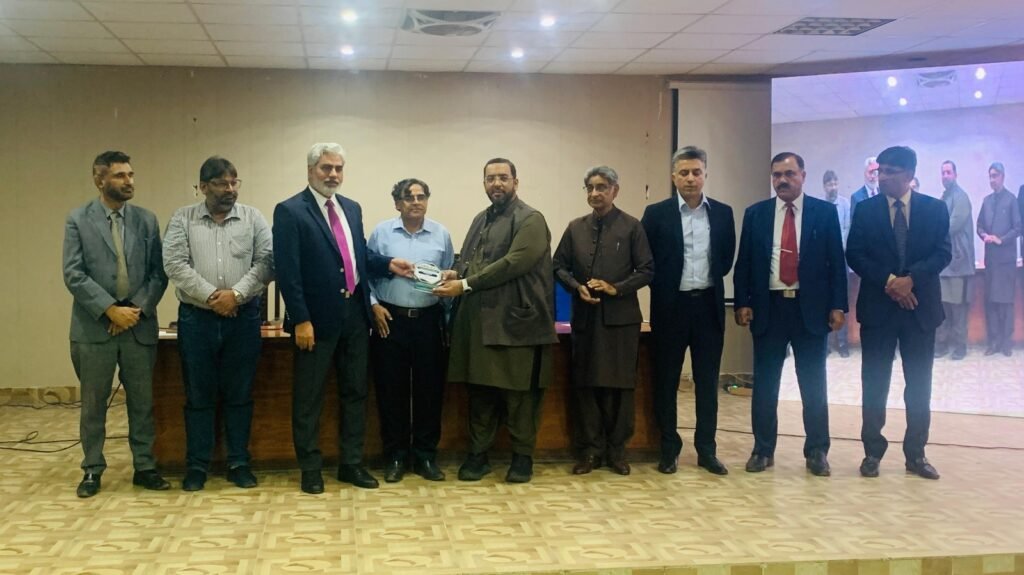
MULTAN: Prof. Dr. Javed Ahmed, Dean, Faculty of Sciences, presenting a commemorative shield to Khawaja Muhammad Qasim, Central Chairman of APBUMA, at the Climate Action Summit 2026 at Bahauddin Zakariya University.
Bureau Report
MULTAN : Pakistan’s textile and apparel exporters must accelerate their shift to cleaner production, energy efficiency and internationally recognised sustainability standards to remain competitive in global markets, industry leaders and environmental experts said at the second two-day BZU Climate Action Summit 2026.
Organised by the Department of Environmental Sciences, Bahauddin Zakariya University (BZU), in collaboration with Alternate Development Services (ADS), the summit highlighted growing international demands for verified emissions data, supply-chain traceability and ESG compliance.
Speakers noted that exports to the European Union, Pakistan’s largest textile market, amounted to around $7.1 billion out of $17.9 billion in total textile exports in FY2025-26. They said sustainability standards were becoming increasingly important for maintaining market access, particularly under the GSP+ arrangement.
Khawaja Muhammad Qasim, Central Chairman of APBUMA, said a clean environment was essential for both industry and communities. He urged industrialists to take responsibility for reducing emissions rather than wait for government intervention, identifying solar power, battery storage and wind energy as important alternatives, particularly highlighting Balochistan’s potential for wind power.
Prof. Dr. Javed Ahmed, Dean, Faculty of Science, BZU, stressed stronger academia-industry linkages to address environmental challenges. He said universities could support businesses through research, data collection, software development and technical expertise, while internships could prepare students for emerging sustainability professions.
Amjad Nazeer, CEO of ADS, said carbon emissions were increasingly influencing international trade and competitiveness, warning that Pakistani exporters risked losing orders if they failed to meet sustainability requirements and provide reliable environmental data.
Highlighting the SECP’s ESG Disclosure Guidelines and Pakistan Green Taxonomy, he said promotion of green production and sustainability reporting, including through Global Reporting Initiative (GRI) standards, required effective implementation. He observed that most Pakistani textile companies were still at an early stage of carbon disclosure, GRI reporting and greenhouse gas (GHG) accounting, making accelerated capacity building essential.
Nazeer stressed that ESG compliance was crucial for maintaining Pakistan’s preferential access to the EU under GSP+, which is due for renewal under the upcoming review. He said compliance could help exporters strengthen their position in the EU market, where Pakistani textile exports had remained around $7-8 billion for an extended period. He also highlighted the roles of the Science Based Targets initiative (SBTi) and measurement, reporting and verification (MRV) systems, adding that carbon accounting was creating new career opportunities.
During a policy dialogue moderated by Dr Muhammad Dawood, industry representatives discussed the financial, technical and regulatory challenges of the green transition. Dr Zafar Iqbal of the Environmental Protection Agency said decarbonisation was necessary for industrial competitiveness and environmental protection.
Hammad Haseeb Rao of Zephyrs Textile said sustainability compliance must extend across the entire value chain, from cotton cultivation to finished products. He identified reliable supply-chain data, verification and traceability as major challenges, stressing digital product passports and a centralised software system for carbon accounting.
Basharat Hashmi of Fazal Cloth Mills called for a clear government roadmap and financial support, saying shrinking profit margins and inadequate solar energy policies were making the transition difficult. Shakeel Ahmad