Every nation that has climbed into the ranks of prosperous economies over the past half-century has learned the same lesson: universities cannot be mere warehouses of knowledge; they must be engines of growth. Stanford’s laboratories helped seed Silicon Valley. Israel’s research institutions fed a start-up ecosystem out of all proportion to the country’s size. Germany’s Fraunhofer institutes carry applied research onto the factory floor, and China’s university-linked science parks, with Beijing’s Zhongguancun the best-known example, have become the beating heart of its technology rise.
The true measure of a university today is what leaves its gates: capable graduates, patents, products, companies and jobs.
Pakistan stands at that crossroads. Its higher education sector has grown in output and ambition, yet the bridge between laboratory and marketplace remains fragile. This month in Lahore, Punjab’s higher education leadership set out to strengthen it. Through a five-year strategy for 2026–2030 and a landmark innovation expo, the province has signalled that it wants its universities judged not by enrolment figures but by their economic and social impact.
A Blueprint Built on Six Pillars
 The strategy has been framed under the leadership of Professor Dr Iqrar Ahmad Khan, Chairman of the Punjab Higher Education Commission (PHEC). Its ambition is to bring the province’s universities closer to the world’s best and to make them dependable sources of knowledge, employment and national prosperity. The underlying conviction is that genuine transformation cannot come from administrative reshuffling. It demands institutional autonomy, professional leadership, measurable performance and a deep connection with society.
Six interlocking pillars give shape to that conviction. The first links autonomy with accountability: performance-based governance, clear targets and better recurring grants. The second treats human capital as Pakistan’s most valuable asset, tying scholarships, global certifications and labour-market analysis to what is taught. The third aims to make quality a continuous habit rather than an occasional examination. The fourth encourages shared research centres that pool the strengths of several universities without constructing new buildings. The fifth uses digital systems and artificial intelligence to monitor performance and strengthen financial sustainability, and the sixth plugs Punjab’s institutions into global academic networks.
There is nothing exotic in this architecture, and that is its strength. Leading systems from Singapore to Finland have followed a similar logic: give universities freedom, hold them to transparent outcomes, and reward collaboration over duplication. Punjab’s distinctive insistence is that universities must deliver benefits ordinary citizens can see, a demanding standard and a welcome one.
PINTECH 2026: Where Ideas Meet the Market
 The Honhar Punjab Innovation and Technology Expo, PINTECH 2026, put the strategy on display on 14 and 15 November at the Royal Palm Golf and Country Club in Lahore. University leaders, researchers, students, policymakers, industry representatives and international guests gathered under one roof. Some 1,480 projects from 35 universities entered the initial round, and about 380 shortlisted projects were presented to nearly 20,000 participants. The numbers are impressive, but the true measure will be how quickly promising ideas become patents, saleable technologies and jobs.
A Chinese pavilion lent the event an international dimension. Held in the 75th anniversary year of Pakistan–China friendship, the expo hosted eleven academic delegations and four industry representatives from institutions including Peking University, the Gansu Academy of Agricultural Sciences, Northwest A&F University and Southwest University. Seventeen memorandums of understanding were signed. Memorandums, however, are starting points. The experience of countries that have gained most from international research partnerships shows that value arrives only when agreements mature into joint papers, shared patents and co-developed products.
 Agriculture and food security, the backbone of Punjab’s economy, received particular attention in a session moderated by Professor Dr Asif Ali (Tamgha-i-Imtiaz), Vice Chancellor of Muhammad Nawaz Sharif University of Agriculture, Multan. He presented farming not as a matter of crop yields alone but as a system linking farmers, researchers, machinery, markets, livestock and private capital. Small growers, he argued, cannot individually afford precision technology, so modern machinery should reach them as a service. He also stressed the post-harvest stage: investment in storage, transport and processing cuts losses and, in effect, produces an additional crop. Livestock opportunities, farmer training and corporate social responsibility programmes that enable women entrepreneurs completed a picture in which food security becomes a national security priority. The same whole-chain thinking lies behind the agricultural leaps of the Netherlands and Brazil.
Other voices widened the frame. Journalist Suhail Warraich delivered a candid address on universities and industry, arguing that degrees and papers alone cannot lift a nation unless research is permanently tied to production, and that industry engagement is a core responsibility of universities, not a side activity. He pointed to China’s planned alignment of industry and academia and to Israel’s ability to build a technology hub from limited resources through close links between research, defence technology and the private sector. Pakistan, he warned, risks missing yet another train unless decision-makers act seriously, and he singled out modern data centres as the foundation of an AI-driven economy.
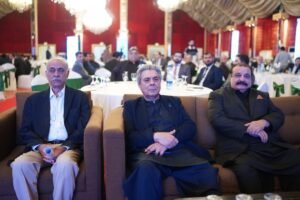
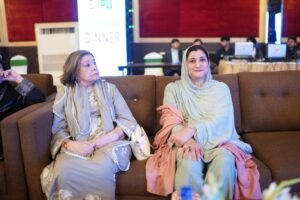 Panellists added further perspectives. Dr Bushra Mirza, Vice Chancellor, and Dr Shazia Anjum, Vice Chancellor of Women University Bahawalpur, stressed women’s participation in science. Dr Tariq Banuri argued that no national strategy is complete without climate resilience. General Muhammad Asghar, Vice Chancellor of Bahauddin Zakariya University, pressed for performance-based accountability, while Dr Ashfaq Ahmed Chattah, Vice Chancellor of Ghazi University, and Dr Zeb-un-Nisa spoke on academic quality. General Khalid Maqbool, former Governor of the Punjab, whom higher education reformers and leading intellectuals commonly call the “Sir Syed of Pakistan”, and Hafeezullah Niazi shared experience on governance and the business climate, and senior journalist Chaudhry Khalid Qayyum offered the media’s view of the research–industry relationship.
Behind the scenes, Dr Asif Munir, Director General of the Punjab Higher Education Commission, oversaw institutional coordination, while Shahir Ahmad Sheikh, Principal Secretary to the Chairman, ensured every element ran on time. The active participation of Dr Zulfiqar Ali, Vice Chancellor of the University of Agriculture Faisalabad, and his faculty also contributed to the expo’s success, a reminder that such gatherings depend on real alignment among universities, government and international partners.
Crossing the Valley of Death
 The most thought-provoking address came from Professor Dr Sohail H. Naqvi, Member of the Higher Education Commission, former Executive Director of the HEC and former Vice Chancellor of LUMS. Delivering a keynote on health innovation and artificial intelligence on 15 November at the Pearl Continental Hotel, Lahore, he examined the gulf between research and commerce, what innovation scholars call the “valley of death”, where promising prototypes perish for want of funding, regulatory pathways and customers.
Pakistan’s research capacity, he argued, has grown substantially. The country stands 26th in the 2025 SCImago global rankings, has published 45,576 research papers, and now produces 3,262 PhD graduates a year, up from 877 in 2010–11. These are real gains since the HEC was established in 2002.
Pakistan’s problem is not a shortage of knowledge but the absence of a system that turns knowledge into products.
Yet roughly 98 percent of the medical devices used in Pakistan are imported. Dr Naqvi illustrated the gap with the pandemic: about fifty ventilator prototypes were built, only two won regulatory approval, and four years later none had achieved commercial success. Engineering talent alone cannot sustain a medical industry. It needs interdisciplinary teams, intellectual-property protection, clinical validation, regulatory clearance, capital and, above all, a committed first buyer. He outlined six stages from discovery to patient and observed that Pakistan has made meaningful progress only in the first. The Pakistan Atomic Energy Commission’s radiopharmaceutical programme offers the counter-example: when hospitals become the first customers of locally made products, commercial success follows.
The global record supports him. The United States’ Bayh-Dole Act of 1980 allowed universities to own and license inventions made with public funds, unleashing a wave of technology transfer. The Small Business Innovation Research programme, created in 1982, then bridged the early-stage funding gap, with public agencies acting as patient early customers. Israel’s Yozma programme of the 1990s catalysed a venture capital industry by pairing public money with private investors. Germany’s Fraunhofer institutes earn a substantial share of their income from industry contracts, which keeps applied research honest about what the market needs, while the United Kingdom’s Catapult centres, launched in 2011, were designed precisely to carry prototypes across the gap between laboratory and factory. In every case the common thread was a financing bridge and a willing first buyer.
Dr Naqvi’s most promising proposal draws on that experience: a Punjab-level pilot offering equity-free support for the proof-of-concept and commercialisation stages. The proposed fund of Rs1 billion would draw Rs500 million from five participating universities, Rs250 million from the Punjab Higher Education Commission and Rs250 million from the Bank of Punjab. It would operate through a charitable trust and begin in early 2027. Projects proposed under NovaTech X, such as DentaSense and HemoSense, show how medical knowledge, engineering and regulatory expertise can combine to produce world-class local technologies.
Global engagement forms the sixth pillar, and early signs are encouraging. The international linkages programme drew 1,720 applications from experts in 71 countries, including 122 in artificial intelligence and 102 in One Health, and was later adopted by the HEC. Partnerships with Washington State University, the University of South Dakota and institutions in California could strengthen joint research and technology transfer, provided they move beyond paper agreements into shared publications, patents and tradeable inventions.
From Vision to Verification
The message of the strategy, the expo and Dr Naqvi’s address converges: Pakistan must move from producing research to using and commercialising it. Five priorities follow.
- Fund the bridge. Launch the proposed Rs1 billion proof-of-concept and commercialisation trust on schedule in early 2027, with transparent selection criteria and backing for teams that have a clear route to market.
- Create first buyers. Hospitals, agribusinesses and government departments should commit to trialling and procuring locally developed technology.
- Reward outcomes. Judge universities by patents licensed, companies launched, jobs created and income earned from industry, alongside enrolment and publications.
- Turn memorandums into results. Track each of the seventeen agreements through joint papers, shared patents and co-developed products.
- Build the foundations. Invest in modern data centres, clear regulatory pathways for medical devices, and shared priorities in agriculture, food security, artificial intelligence, One Health and climate resilience.
 Success should be counted not in exhibitions held but in technologies that thrive in the market, businesses launched and jobs created. Punjab has built an open field for this ambition; the real test now is execution, consistency and visible results. The future belongs to institutions that can turn ideas into opportunity and knowledge into shared prosperity. That journey, from thought to industry and eventually to every Pakistani household, has begun. It must not stall.
The writer is a former Professor & Head, Department of Entomology, UAF. He is reached at jalalarif807@yahoo.com