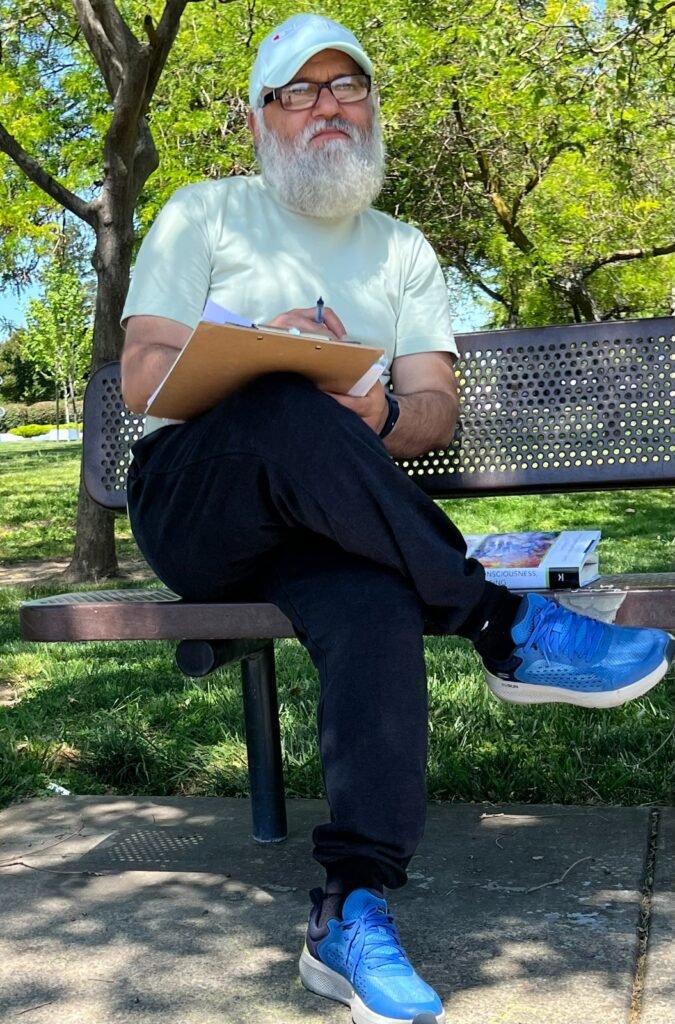
The Courage to Accept Yourself, Break Free from Conditioning, and Rediscover the Joy of Being Alive
Dr. Pardeep Nanglu
At some point in life, the familiar begins to feel like a prison. The same thoughts return every morning, the same habits shape our days, and the same expectations determine our decisions. We continue moving, working, fulfilling responsibilities, and meeting social demands, yet somewhere within us, a quiet dissatisfaction grows. We may have everything that society considers necessary for a successful life, but still feel that something essential is missing.
Perhaps the problem is not that life has become empty. Perhaps we have become too accustomed to living it according to someone else’s definition.
To jump out of the rut is not merely to change our surroundings, abandon our responsibilities, or pursue something new. It is to question the unconscious patterns through which we experience ourselves and the world. It is to rediscover the freedom to live consciously rather than mechanically.
The Difference Between Accepting Yourself and Accepting Your Conditioning
From childhood, we are taught how to behave, what to believe, what to pursue, and what to avoid. Families, educational institutions, religious traditions, cultural expectations, and social structures all contribute to shaping our identities. Much of this guidance helps us develop cooperation, discipline, and a sense of belonging. However, problems arise when we begin to mistake everything we have learned for everything we are.
We may learn to suppress our emotions because vulnerability is considered weakness. We may choose a career to satisfy our family rather than follow our interests. We may remain in relationships, habits, or social roles simply because leaving them would invite criticism. Gradually, the voice of our authentic experience becomes quieter than the voices of expectation.
Self-acceptance requires us to examine this difference.
Accepting ourselves does not mean approving every habit, defending every mistake, or refusing to grow. It means acknowledging our present reality without pretending to be someone else. We can recognise our fears without allowing them to govern us, acknowledge our limitations without turning them into permanent identities, and accept our past without allowing it to dictate our future.
The first step towards freedom is honest self-awareness. We cannot transform a pattern that we refuse to recognise.
The Invisible Prison of Other People’s Expectations
Many people spend their lives trying to become acceptable in the eyes of others. They seek approval through professional achievements, financial success, appearance, social status, and recognition. Their happiness becomes dependent on external validation, while their inner lives remain neglected.
The tragedy is that the standards they try to meet may never stay constant. Today’s achievement becomes tomorrow’s expectation. One success creates pressure for another, and the pursuit of recognition becomes an endless race.
When we organise our lives around the opinions of others, we gradually surrender the authority to determine what makes our lives meaningful.
This does not mean that other people’s opinions are worthless. Feedback can help us learn, relationships require consideration, and society depends on mutual respect. The essential question is whether we listen to others thoughtfully or obey them automatically.
A mature individual can appreciate advice without surrendering independent judgment. We can respect tradition without being imprisoned by it, participate in society without losing our individuality, and love our families without abandoning our deepest convictions.
Freedom begins when we understand that we are not required to spend our entire lives proving our worth.
When Boredom Becomes an Invitation
Boredom is usually treated as an unpleasant experience that must be eliminated. We reach for our phones, search for entertainment, fill our calendars, or look for another distraction. Yet persistent boredom can sometimes reveal something important: our existing way of living may no longer engage our curiosity, creativity, or sense of purpose.
A repetitive life is not necessarily an unfulfilling one. Routine provides stability, and ordinary responsibilities are essential. The difficulty begins when routine becomes unconscious repetition and stability turns into stagnation.
We may continue doing things simply because we have always done them. We stop asking whether our habits serve us, whether our relationships encourage mutual growth, or whether our daily activities reflect our values.
Instead of immediately escaping boredom, we can become curious about it.
What am I avoiding? Which part of my life have I stopped questioning? What have I postponed because I fear failure or disapproval? What would I explore if I were less concerned about appearing foolish?
These questions transform boredom from a condition of helplessness into an opportunity for reflection.
Sometimes the change we need is not dramatic. It may involve learning a new skill, returning to an abandoned creative interest, developing healthier relationships, spending time in nature, or allowing ourselves to experience silence without distraction. The purpose is not constant excitement. It is renewed participation in our own lives.
Responsibility Means Responding to Reality
The word responsibility is often associated with duties, obligations, and the demands imposed upon us by others. While these are important aspects of life, responsibility has another practical dimension: the ability to respond consciously to the reality before us.
We cannot always choose our circumstances. We may experience rejection, financial hardship, illness, loss, discrimination, or unexpected change. Nor can we control the behaviour of other people. However, within the limits of our circumstances, we can often examine our choices, seek support, and determine our next constructive step.
This understanding of responsibility is different from blaming people for every difficulty they experience. Human lives are shaped by social conditions, access to resources, relationships, biology, and events beyond individual control. Recognising these realities is part of responding intelligently rather than pretending that every problem can be solved through willpower alone.
Personal responsibility begins by distinguishing between what we can influence and what we cannot.
We may not be able to change yesterday’s decision, but we can learn from it. We may not be able to force someone to understand us, but we can communicate honestly. We may not be able to eliminate uncertainty, but we can prepare for it.
The question is no longer simply, “Why is this happening to me?” It also becomes, “Given what is happening, what is the wisest response available to me?”
This shift does not erase pain. It restores a measure of agency within it.
The Courage to Leave the Familiar
Even when our circumstances make us unhappy, familiarity can feel safer than change. The mind often prefers a known discomfort to an uncertain possibility. We remain in unsatisfying situations because we fear losing security, disappointing others, making mistakes, or discovering that our new direction may not work.
Consequently, we postpone decisions until the opportunity has passed or our dissatisfaction becomes unbearable.
Courage does not mean acting without thought. Important decisions deserve reflection, particularly when they affect our families, finances, health, or professional commitments. But reflection can become another form of avoidance when we endlessly analyse possibilities without taking any meaningful step.
The challenge is to distinguish careful preparation from fear disguised as prudence.
We do not need to overturn our entire lives overnight. We can begin with one honest conversation, one changed habit, one application, one creative project, or one boundary that protects our well-being. Small actions can gradually weaken the hold of old patterns.
Sometimes the most courageous decision is to begin. At other times, it is to wait, seek guidance, or change direction responsibly. The essential quality is conscious choice rather than automatic obedience to fear.
Beyond Labels, Towards Authentic Living
People frequently define themselves through labels: successful or unsuccessful, educated or uneducated, respectable or disreputable, strong or weak. These descriptions may capture aspects of our experience, but they cannot contain the full complexity of a human being.
When we become too attached to a label, we may begin organising our lives around protecting it. A person who believes they must always appear strong may find it difficult to ask for help. Someone who identifies exclusively with professional success may experience a setback as a collapse of personal worth. Another person may remain trapped in the belief that past mistakes permanently define them.
Authentic living requires room for change.
We are capable of learning, reconsidering our beliefs, repairing relationships, and developing new ways of responding. Our identity need not be a fixed monument built from yesterday’s experiences. It can remain an evolving understanding of who we are and what matters to us.
This openness also encourages compassion towards others. When we recognise that our own behaviour has been shaped by experiences and expectations, we become more willing to understand the struggles of people whose lives differ from ours. Understanding does not require agreement, but it can replace unnecessary judgment with curiosity and respect.
Rediscovering the Joy of Being Alive
Joy is often imagined as the reward waiting at the end of achievement: after earning more money, gaining recognition, reaching a goal, or finally satisfying everyone around us. Yet a life devoted entirely to future rewards can leave little room to experience the present.
The ordinary moments we overlook may contain much of what makes existence meaningful: a conversation without pretence, the warmth of sunlight, the beauty of a tree, the companionship of someone who listens, or the simple pleasure of creating something without needing applause.
Being present does not mean ignoring difficulties or abandoning ambition. It means allowing ourselves to experience life while we are living it, rather than treating the present merely as a waiting room for a better future.
When we accept ourselves honestly, question inherited assumptions, and take responsibility for our responses, we create room for a more spontaneous and meaningful existence. We become less preoccupied with performing an identity and more interested in experiencing reality.
The purpose is not to become perfect. It is to become more conscious, more flexible, and more truthful in the way we live.
The Final Leap
Perhaps the most important question is not whether we are living the life that others admire, but whether we are participating in a life that feels genuinely our own.
Are our decisions guided by awareness or by habit? Are we choosing our beliefs or merely repeating them? Are we accepting ourselves, or endlessly negotiating our worth with the world? Are we fulfilling meaningful responsibilities, or simply obeying expectations we have never examined?
These questions do not demand immediate answers. They invite us to begin looking.
Jumping out of the rut does not mean escaping life. It means escaping the unconsciousness with which we sometimes live it. It means recognising that change is possible, that mistakes need not become permanent prisons, and that courage can begin with a single honest decision.
Life will continue to bring uncertainty, responsibilities, and challenges. We cannot control every turn in the road, but we can become more aware of how we travel it.
The leap begins when we stop waiting for permission to become ourselves. We do not need to reject the world to discover our freedom, nor do we need to win its approval before we begin living meaningfully.
Sometimes, the door to a different life is not locked at all. We have simply become so accustomed to the room that we have forgotten we can walk out.
The real leap is from living by default to living by awareness. And that leap can begin today.
Author: California-based Psychology & Mental Health Professional. Board-Certified Holistic Health Educator.He can be reached at DRPNANGLU@outlook.com