

 Muhammad Saeed Chishti Nizami
Every year on October 16, the Member countries of the world observes World Food Day to renew its commitment to ending hunger, improving nutrition and ensuring that every human being has access to sufficient, safe and nutritious food. The day marks the founding of the Food and Agriculture Organization of the United Nations (FAO) in 1945. Yet, more than eight decades later, hunger remains one of humanity’s most persistent challenges.
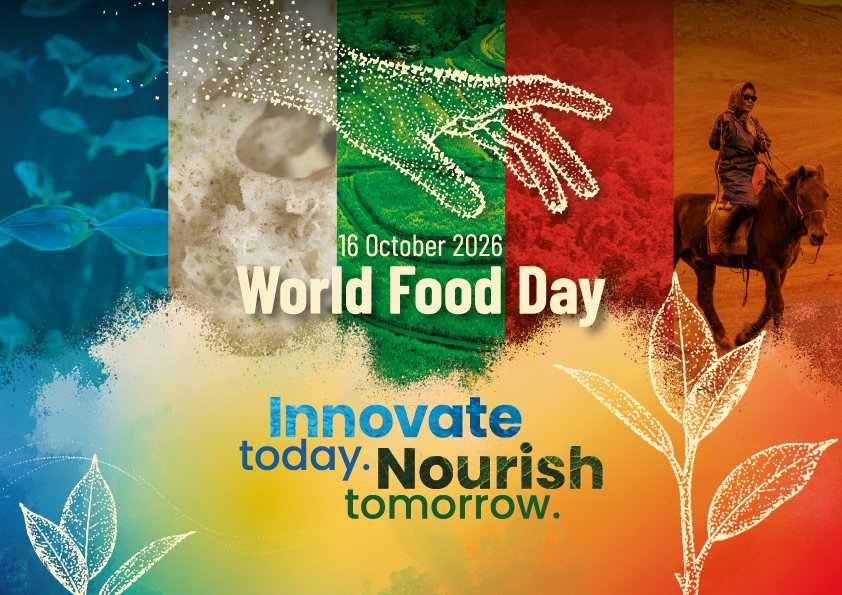
The official theme for World Food Day 2026, “Innovate Today. Nourish Tomorrow,” highlights the importance of scientific progress, traditional knowledge and collective action in building sustainable and inclusive food systems. It also raises a fundamental question: if farmers across the world work tirelessly to produce food, why do so many people still go hungry?
According to FAO’s latest global estimates, approximately 645 million people faced hunger in 2025, while around 2.1 billion experienced moderate or severe food insecurity. These figures reveal the scale of a challenge that cannot be addressed through increased production alone. The world’s food challenge is not simply a question of growing enough crops. Food must also be affordable, nutritious, accessible and available where it is needed. Poverty, conflict, climate-related disasters, economic instability, weak distribution systems and unequal access to resources all contribute to hunger.
Food security rests on a simple principle: food must be available, people must be able to afford it, and it must provide the nutrition required for a healthy life. A country may produce substantial quantities of wheat, rice, vegetables, milk and meat, yet its poorest citizens may still struggle to obtain a balanced meal.
Food waste adds another dimension to the problem. When edible food is lost during harvesting, storage, transportation, processing or marketing, the efforts of farmers and the resources invested in production are wasted. Better storage facilities, modern supply chains, food processing and responsible consumption can help reduce these losses and make more food available to consumers. Ending hunger therefore requires an integrated approach that connects agricultural research with production, markets, nutrition and social protection.
Farmers Deserve Fair Returns for Their Labor – Farmers are at the heart of every food system. They invest their time, land, water, labor and savings to produce food for society. Yet, in many countries, small farmers remain economically vulnerable. Rising costs of seed, fertilizer, fuel, electricity, machinery and irrigation can reduce their earnings even when their harvests are satisfactory.
An especially serious concern arises when farmers sell their produce at low prices but consumers subsequently face high retail prices. The difference may reflect transportation, storage, processing and other legitimate costs, but weak competition, excessive intermediary margins and market manipulation can also contribute. The result is an unjust situation in which farmers struggle to recover their production costs while consumers find essential food increasingly unaffordable.
Governments must therefore establish transparent agricultural markets, improve market information, strengthen farmers’ organizations and cooperatives, and ensure effective competition. Fair and predictable pricing arrangements, accessible agricultural credit, reliable storage facilities and direct links between producers and buyers can improve farmers’ bargaining power. International cooperation is also needed to promote fair agricultural trade and protect vulnerable producers from exploitative practices. The objective should be clear: farmers must receive a reasonable return for their investment, while consumers must have access to food at affordable prices.
Food security cannot be achieved sustainably if those who produce food cannot afford to live with dignity. Innovation Must Reach the Farmer: The 2026 World Food Day theme rightly places innovation at the Centre of the global food agenda. Innovation, however, should not be understood merely as advanced machinery, artificial intelligence or digital technology. It also includes improved seed varieties, better livestock breeds, efficient irrigation, climate-resilient farming, integrated pest management, soil conservation and the practical knowledge of farming communities.
Scientific research can help farmers produce more with fewer resources. Climate-smart agriculture can reduce vulnerability to droughts, floods, heatwaves and changing rainfall patterns. Digital advisory services can provide timely information about weather, crop diseases, market prices and recommended farming practices. Similarly, improved storage, cold chains, food processing and value addition can reduce post-harvest losses and create new sources of income in rural areas. Yet innovation achieves its true purpose only when its benefits reach ordinary farmers, particularly smallholders, women and young people. Research institutions, universities, governments, private enterprises and farming communities must work together to turn scientific discoveries into practical solutions. Investment in agricultural research and extension services is therefore not merely a sectoral expense; it is an investment in national prosperity, public health and long-term food security.
For Pakistan, World Food Day carries particular significance – Agriculture supports rural livelihoods, supplies food and raw materials, and contributes substantially to the national economy. Improving agricultural productivity, strengthening livestock health, conserving water and developing climate-resilient crops are essential to meeting the country’s growing food requirements. Over the years, PARC, in collaboration with FAO, has implemented numerous projects aimed at improving the livelihoods and incomes of Pakistan’s farming communities. These initiatives have supported livestock, dairy, crops, vegetables, poultry and other agricultural activities, encouraging improved technologies, production practices, farm management and value addition.
Such collaboration demonstrates the importance of combining international expertise with local research and the practical experience of farming communities. Stronger coordination among research institutions, extension services and farmers can help ensure that scientific advances are adopted widely rather than remaining confined to research facilities.
Women, Youth and Collective Responsibility: Women play vital roles throughout agri-food systems, from crop production and livestock management to food processing, household nutrition and rural enterprise. Their contribution deserves greater recognition, better access to training, finance, technology and markets, and meaningful participation in agricultural decision-making. Young people, meanwhile, can bring fresh ideas to agriculture through digital technologies, entrepreneurship, mechanization and innovative food businesses. Making agriculture more productive and financially rewarding can encourage a new generation to view it as an opportunity rather than a last resort.
Governments must provide supportive policies and invest in agricultural research, rural infrastructure, education and nutrition. The private sector should contribute through responsible investment and efficient supply chains. Research institutions must develop practical solutions, while farmers and their organizations should have a meaningful voice in shaping agricultural policies. Consumers also have a responsibility to reduce food waste, make informed choices and value the labor and resources involved in producing food.
A Shared Promise for Tomorrow: World Food Day should be more than an annual observance. It should serve as a reminder that food is fundamental to human dignity, health and social stability. No society can achieve lasting prosperity while a substantial part of its population remains hungry or malnourished. The challenge before the international community is to connect innovation with justice, research with practical application, and agricultural productivity with the purchasing power of ordinary people. Increasing production matters, but so do fair markets, responsible governance, reduced food waste and equitable access to nutritious food.
As the world marks World Food Day 2026 under the theme “Innovate Today. Nourish Tomorrow,” the message is both simple and urgent: scientific progress must improve human lives, farmers must receive fair returns for their labor, and nutritious food must become accessible to everyone. The ultimate measure of agricultural success is not merely how much food a nation produces, but whether its farmers can prosper and its people can afford to eat.
s# # # # #