Engnier Shazaib jameel
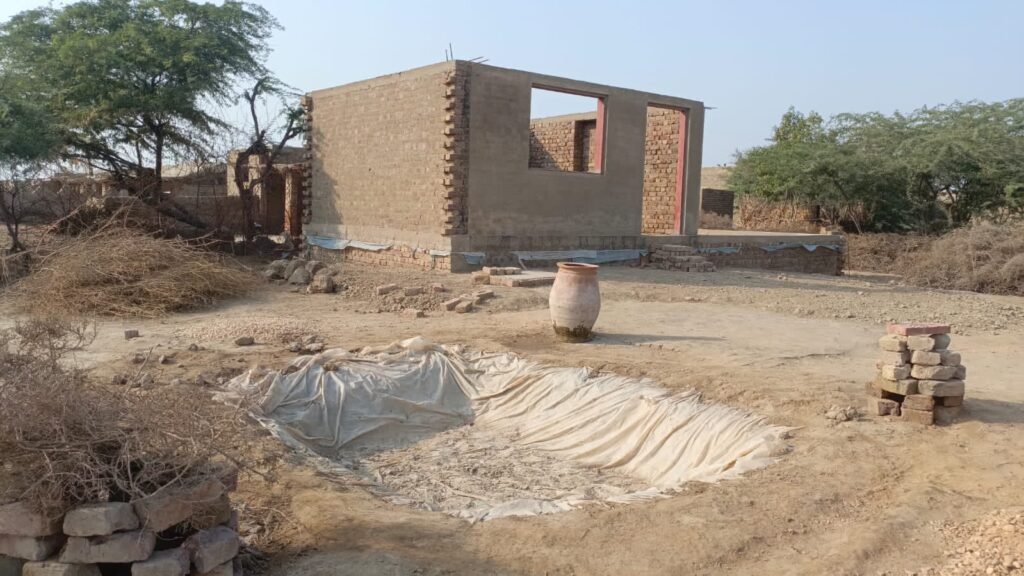
Water is one of the most essential resources in the construction industry, playing a vital role in almost every stage of building a house, from brick masonry and plastering to curing concrete and other construction activities. However, the unavailability of water in many rural areas of District Mirpurkhas (MPK) creates serious challenges for construction teams and can affect the timely completion of houses. Under the Sindh Peoples Housing for Flood Affectees (SPHF) programme, construction activities are being carried out across Sindh to help flood-affected families rebuild their homes and restore their lives. In Goth 333, Union Council Hadi Bux Dhonkai, Taluka Kot Ghulam Muhammad, District Mirpurkhas, water scarcity presented a practical challenge for ongoing construction work. To address this issue, Engineer Masood introduced a simple, innovative, and cost-effective idea: constructing a temporary water storage pond lined with a polyethylene sheet to prevent water from seeping into the ground. The concept is straightforward but useful: a suitable area is excavated, the surface is prepared, and a polyethylene sheet is placed inside the pond to retain the stored water for construction purposes. This arrangement can help make water available near construction sites, reducing the difficulties faced by workers who otherwise have to arrange water from distant locations. The stored water can be used for essential construction activities, including brick masonry, plastering, and curing of concrete, subject to appropriate water quality and technical requirements. By improving the availability of water at the worksite, this approach has the potential to reduce interruptions, improve work continuity, and support the timely completion of houses for deserving beneficiaries. The idea also highlights an important principle of civil engineering: solutions do not always need to be expensive or technologically complex to be effective. A clear understanding of site conditions, available resources, and local requirements can help engineers develop practical measures that address everyday construction problems. In this regard, the role of the National Rural Support Programme (NRSP) in capacity building is also important. Through field experience, technical guidance, coordination, supervision, and knowledge sharing, engineers can strengthen their ability to identify challenges and develop appropriate solutions. Capacity building is not limited to formal training; it also includes learning from practical situations, sharing successful experiences, and encouraging technical staff to think creatively when conventional approaches face difficulties. When engineers are supported in applying their professional knowledge to real-world problems, they can contribute more effectively to construction quality, resource management, and project implementation. The SPHF programme itself represents a major effort to support flood-affected communities through housing reconstruction across Sindh. Implementing such a large-scale programme requires close coordination among engineers, field teams, management, contractors, and communities. Alongside construction targets and quality standards, field teams must address local challenges related to water availability, transportation of materials, labour management, and site conditions. Practical initiatives such as Engineer Masood’s proposed water storage pond demonstrate how local solutions can complement broader programme objectives. If technically assessed and implemented appropriately, similar approaches may be considered in other villages where water scarcity affects construction activities. Sharing such experiences can encourage innovation, promote learning among field engineers, and help teams adapt their methods according to local needs. The initiative from Goth 333, Union Council Hadi Bux Dhonkai, is therefore more than a temporary arrangement for storing water; it is an example of practical thinking in response to a genuine field challenge. It demonstrates the value of combining engineering knowledge, institutional support, and an understanding of community needs to improve the construction process. Ultimately, the success of housing reconstruction depends not only on financial resources and construction targets but also on the commitment, problem-solving abilities, and technical contribution of the people working on the ground. Engineer Masood’s idea sends a valuable message to the construction sector: when resources are limited, engineers must identify the problem, explore feasible alternatives, and develop solutions that meet local requirements. With the support of NRSP’s capacity-building efforts and the continued implementation of SPHF housing reconstruction activities, practical innovations like this can help overcome site-level difficulties and contribute to the timely delivery of safer homes for flood-affected families in rural Sindh. Sometimes, a simple engineering idea can make a meaningful difference—not because it is complicated, but because it responds directly to a real problem faced by the community.