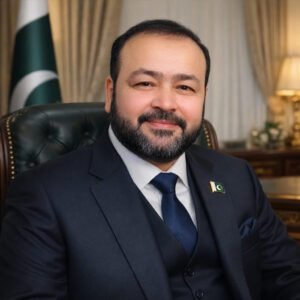
Sajjad Hussain
China is not building a post-Western international order; it is just trying to become the international order’s next leading power. This is a rather plausible statement. In the last 20 years, China has grown at a more rapid rate than anticipated in economic, military, technological and diplomatic power and has challenged some of the existing international system. However, this is seeing the world shift in a way that China’s march to replace Washington is only a part. The electric current is no longer being concentrated on one western main core, but spreading out on multiple cores. That dispersal is a huge part of China’s influence, but it’s also one that may be a Western order of things being made optional and more significant historically for China is its emergence as the next hegemon.
The Problem
The order that developed following 1945 is very much Western oriented. Western institutions, such as the IMF and World Bank had come into being, and long have been shaped by Western priorities. This balance of power has changed, however. China is now amongst the global leaders in economy and diplomacy and countries throughout the Global South are seeking greater space for manoeuvre. The question is not rhetorical, is China becoming the new dominant power, or does it represent a new form of dominance, a powerless power system?1
My Argument
I would like to propose that it is because China is establishing other institutions, other setups, other forms of alliances with other states across the Global South, and because China is expanding the range of options states had when they were forced to operate under Western-led rules and regulations. It is because China is creating other institutions, other alliances, other forms of cooperation with other states across the Global South, and because China is expanding the range of possibilities for states that had little choice but to work in the Western order. It’s not likely to be a world run by the Chinese. This is a “true” multipolar one, in which no single actor determines all the other actors actions.
Building Alternatives
The most obvious manifestation of this trend is China’s increasing influence in institutions that are alternatives to Western-led institutions. The Asian Infrastructure Investment Bank, the Belt and Road Initiative and China’s involvement in organizations such as the Shanghai Cooperation
Organization are all directed towards the same purpose; a broadening of the institutional framework for Chinese influence abroad.2
Here, the economic pay off of any one project is not the only consideration. The measures provide countries with new avenues to finance, establish infrastructure, trade, and diplomatic relations. But it is not the countries that are turning their backs on Western institutions, it is the ones that now have more doors to select from.
These are the same ideas expressed by BRICS in another way. That it is not exclusively Chinese frustration at the distribution of global power that is growing is reflected in its increase in membership. Many developing economies are seeking more influence in the decisions made around the world and less reliance on institutions traditionally dominated by Western nations. China benefits from that mood but it is not the first to create it: it is a current that is sweeping across the world toward institutional pluralism.3
Strategic Autonomy in the Global South
The second half of this story is that of Global South countries premium on strategic independence. The other half of this story is the premium placed by the Global South countries on strategic independence. Mostly, in an age of cold war, international politics could be understood in terms of the two opposing blocs. This system no longer suits the times. The modern developing and middle power states make a conscious effort to not fall into a camp of any one great power.
China offers these states another choice: They can have a partner for infrastructure, trade, investment, technology and diplomacy. It doesn’t mean that to work with China you have to be pro-China. States can develop a relationship with Beijing without losing their relationship with the United States and the European Union, Russia, Japan or their own regional alliances.
This is important because multipolarity is more than merely a matter of numbers of powerful states. Also, it’s about predicting the actual options that are available to smaller and mid-size entities. A country with a number of investment sources, technology sources, security cooperation sources and diplomatic sources is less dependent upon any one patron. In this respect, China is opening up strategic space for the many states. The new order doesn’t prescribe any one country being on one side or the other of China vs. the West, but allows countries to engage in partnerships based on their respective interests.
The Counterargument is Chinese Hegemony?
However, the post-Western thesis has a big issue. China is a great power with its own agenda, its own technological capabilities, economic influence and diplomatic reach and it could very well be that these ‘alternative’ institutions are just tools in its hands for its control.
In this context, replacing Western-based institutions with those put in place by China would not create a “flattening” of the global hierarchy, but rather a new one with the Chinese government sitting where the United States government was.
This is an area that needs to be addressed. As Chinese capabilities grow, the country is increasingly able to turn economic ties into political ones and if it chooses to, it can indeed exercise influence. However, it’s not a foregone conclusion that China will dominate. Other major powers have considerable military and economic power and middle powers are increasingly looking to diversify their partnerships and not being loyal to any one great power, China included.
What makes a difference here is the difference between a post-Western order and a pro-China order. China must be able to break the western monopoly, without having to take over as the new world center of gravity.
Conclusion
The international system is unlikely to change from an American to a Chinese one overnight. What seems more reasonable is a gradual transition to a world of multiple centers of economic, political, technological and diplomatic power. China is relevant to the story here because it provides alternative institutions, partnerships and avenues for cooperation that were missing before.
The question is, though, not if but when China succeeds the United States. It’s whether China’s rise is going to provide other states with more real independence. If its partnerships broaden the choices of developing and middle powers, then China’s rising might have helped to create a more true to form multipolar world. If these same partnerships should instead be forming new dependencies, the “post-Western” order will prove to be nothing new but another hierarchy under a new banner.
Ultimately, the transition that’s taking place could not be a transition from American hegemony to Chinese hegemony, but a transition from a world that is centered on one to a world with no center.
The writer is a student of BS International Relations at the National Defence University.