 Dr Abdul Basit
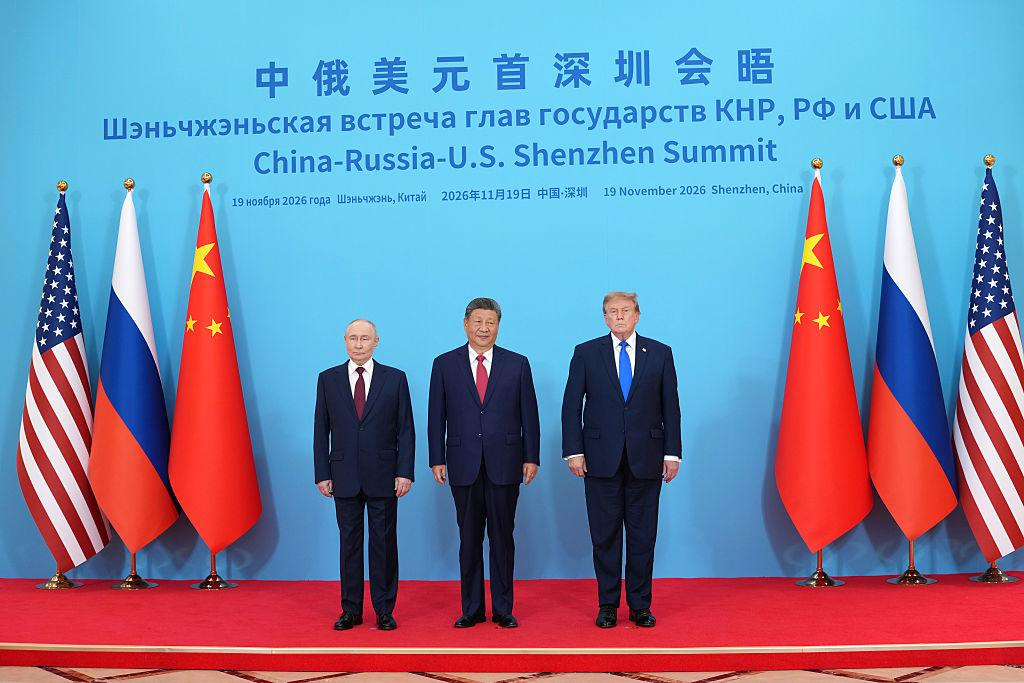
Leaders of the United States, China and Russia convened in Shenzhen for an unprecedented trilateral summit on November 19, 2026, on the sidelines of the APEC Summit. Following roughly 90 minutes of talks, the three leaders issued a joint “Declaration toward Peace.” This trilateral meeting has serious and far-reaching implications for world peace and international diplomacy. Some analysts and officials framed the summit as a historic step toward great-power dialogue, while others argued the outcome was heavy on optics with limited concrete agreements.
A Historic Diplomatic Encounter
The historic trilateral summit in Shenzhen, China, bringing together US President Donald Trump, Chinese President Xi Jinping and Russian President Vladimir Putin, represents a potentially significant development in international diplomacy. The summit concluded with the China-Russia-U.S. Heads of State Declaration toward Peace, outlining four commitments: UN reform, global energy security, state sovereignty and official immunities, and prevention of nuclear war. Although lacking concrete implementation mechanisms, the declaration signals a willingness to pursue cooperation despite deep strategic differences.
Salient Features of the Declaration toward Peace
The Shenzhen Declaration contains four substantive commitments addressing critical dimensions of international governance, economic stability, state sovereignty, and nuclear security. Each carries significant implications for the evolving international order. The first commitment calls for strengthening the United Nations and its capacity to maintain international peace and security. This is particularly significant because the United States, China and Russia, as permanent members of the Security Council, possess veto powers that have frequently obstructed collective action on major international crises. However, the declaration offers no concrete proposals concerning Security Council enlargement, greater representation for developing countries or restrictions on veto powers. The second commitment emphasizes increasing petroleum production and ensuring stable international energy supplies, recognizing the close relationship between energy security, economic growth and geopolitical stability. However, increased petroleum supplies alone cannot overcome challenges arising from geopolitical sanctions, regional conflicts, maritime insecurity and supply-chain disruptions. The declaration also lacks specific mechanisms for coordinating energy policies among the three powers. The third commitment, perhaps the most controversial, emphasizes state sovereignty, official immunities and preventing the misuse of jurisdiction by the International Criminal Court (ICC). It highlights the tension between sovereign authority and accountability for serious international crimes. The provision is particularly significant given the ICC’s arrest warrant against Russian President Vladimir Putin concerning alleged war crimes in Ukraine, which Moscow rejects. The fourth commitment addresses nuclear security, reaffirming that nuclear war cannot be won and must never be fought. Growing strategic rivalries, weakening arms-control agreements and emerging military technologies have heightened nuclear risks. However, the declaration offers no specific commitments concerning arsenal reductions, verification mechanisms or comprehensive arms-control negotiations. Meaningful progress will require sustained strategic dialogue and practical agreements, while recognizing the security interests of other nuclear-armed states, including Britain, France, India and Pakistan.
The Emergence of a New Great-Power Diplomatic Framework
The Shenzhen summit reflects the evolving international order, as American predominance gradually gives way to a more complex distribution of power driven by China’s rise and Russia’s renewed geopolitical influence. The unprecedented trilateral dialogue signals a willingness to manage strategic rivalries through direct engagement and selective cooperation. However, constructive great-power diplomacy must not evolve into exclusive spheres of influence that undermine smaller nations’ sovereignty. Comparisons with the 1945 Yalta Conference remain premature, particularly given the absence of a comprehensive strategic settlement and Europe’s concerns over its exclusion. Ultimately, the summit’s significance will depend on whether it strengthens inclusive multilateralism or establishes a new framework dominated by a few powerful states.
Implications for South Asia and Pakistan
The Shenzhen summit holds particular significance for Pakistan, given its strategic partnership with China, important relations with the United States and expanding engagement with Russia. Improved relations among these powers could provide Pakistan greater diplomatic flexibility, encourage investment, stabilize energy markets and strengthen regional connectivity, including opportunities associated with the China-Pakistan Economic Corridor. As a nuclear-armed state, Pakistan also has a vital interest in international nuclear stability. Any future arms-control arrangements must recognize South Asia’s distinctive security environment, particularly the strategic balance between Pakistan and India. The summit could also encourage cooperation concerning Afghanistan and Central Asia, where the interests of the three powers intersect. Pakistan should capitalize on these diplomatic opportunities while maintaining an independent, balanced foreign policy grounded in national interests, regional stability and the principles of the United Nations Charter.
The Limitations of the Shenzhen Declaration
Despite its diplomatic significance, the Shenzhen Declaration lacks concrete mechanisms for addressing major international conflicts. Although Ukraine and Iran were discussed, neither is specifically addressed in the final document, which offers no ceasefire arrangements, peace-negotiation framework or timetable for conflict resolution. Similarly, commitments concerning nuclear risk reduction, UN reform and energy security remain largely aspirational, without clear implementation measures. Provisions relating to state sovereignty and official immunities may also raise concerns about international criminal accountability. More fundamentally, the declaration leaves unresolved the strategic rivalry between Washington and Beijing, Russia’s confrontation with the West, and competing regional and economic interests. The declaration should therefore be viewed as a promising beginning for sustained diplomatic engagement rather than a comprehensive settlement of global conflicts.
Conclusion: A Potential Turning Point, but Not Yet a New World Order
The Shenzhen Summit represents a potentially significant diplomatic development, bringing together three major powers amid growing international uncertainty. Beyond its four commitments, the Declaration toward Peace signals a willingness by Washington, Beijing and Moscow to pursue dialogue on nuclear security, UN reform, economic stability and international justice. Nevertheless, the summit does not constitute the emergence of a new international order. Fundamental geopolitical rivalries remain unresolved, while concrete agreements on nuclear disarmament, regional conflicts and institutional reforms are still lacking. Its historical significance will depend on whether diplomatic commitments translate into sustained strategic dialogue, meaningful arms-control negotiations and credible conflict-resolution initiatives. Otherwise, the declaration may remain largely symbolic. The true test of the Shenzhen Declaration will be whether its commitments are translated into meaningful action towards a more peaceful, equitable and secure international order.
The writer is Chancellor of Preston University and may be reached at chancellor@preston.edu.pk