Sports Desk
LAHORE: For decades, cricket has dominated Pakistan’s sporting landscape, producing legends, national heroes and enormous commercial opportunities. However, a new contender is emerging beyond the boundary ropes. Mixed Martial Arts (MMA) is rapidly creating its own sporting identity, producing international champions and offering Pakistan an exciting opportunity to expand its global sporting influence.
The country’s growing success is particularly remarkable because it has largely been achieved without the financial resources, infrastructure and institutional backing traditionally available to mainstream sports.
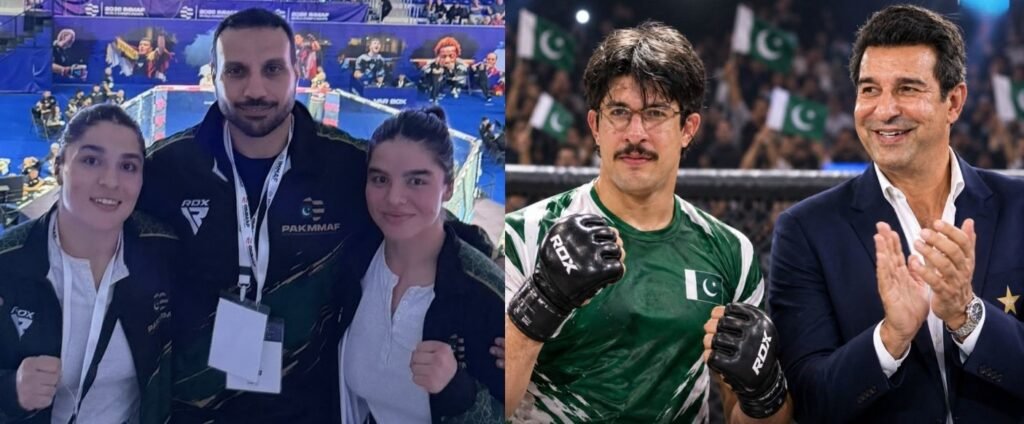
Pakistan’s emerging MMA movement found two remarkable ambassadors at the 2026 IMMAF World Championships in Tbilisi, Georgia. Hunza-born Maliha Ali defeated Russia’s Veronika Drozdova and Mexico’s Andrea Gabriela Guzman Salazar to reach the semi-finals.
Despite competing with a fractured toe, a badly bruised eyelid and an injured jaw, Maliha narrowly lost a split decision against Russia’s Polina Baldina. Following a formal challenge to the scoring by the Pakistan MMA Federation, she finished the championship with a bronze medal.
Her twin sister Manesha Ali had already captured gold at the IMMAF World Cup in Angola, defeating local competitor Leonela Isabel Blaiye through a second-round submission. Maliha also secured silver at the same event.
Their combined achievements represent an extraordinary accomplishment for two athletes from a remote region of Pakistan. Both train at BRAVE Gym Lahore, demonstrating how talent, quality coaching and international exposure can transform sporting careers.
Pakistan’s joint 20th-place finish in the senior medals standings at the 2026 IMMAF World Championships, alongside countries including the United States and Spain, underlines the country’s growing competitiveness. The federation also places Pakistan fifth in Asia.
Under President Omar Ahmed, the Pakistan MMA Federation has worked to establish a pathway connecting domestic competitions, international championships and professional opportunities. Sponsorship, travel arrangements, visas, athlete preparation and international coordination have required considerable private effort.
The achievements raise an important question: how much further could Pakistan progress with consistent government support, corporate investment and a properly funded national development programme?
Perhaps the strongest indication of MMA’s growing appeal comes from the family of legendary Pakistan fast bowler Wasim Akram. His son, Taimur Akram, has chosen a different sporting path, pursuing professional MMA in the United States.
In November 2026, Taimur recorded his fourth consecutive professional victory, extending his unbeaten record to 4-0. Wasim publicly celebrated his son’s achievement, highlighting the growing acceptance of alternative sporting careers among Pakistan’s younger generation.
Cricket remains deeply rooted in the country’s sporting culture, but MMA is increasingly offering young athletes another route to recognition and professional success.
MMA is also connected to an expanding international sports and entertainment industry. Abu Dhabi, Bahrain and Saudi Arabia have invested heavily in combat sports, while the UFC has established itself as one of the world’s most powerful sporting brands.
For Pakistan, this presents opportunities beyond competition, including international events, sponsorships, broadcasting, sports tourism and stronger global relationships. A professionally managed national fight league, supported by grassroots academies and a sustainable competition structure, could help transform the sport into a significant commercial property.
Pakistan’s MMA progress demonstrates what determined athletes, committed coaches and organised private initiatives can accomplish despite limited resources. Maliha and Manesha’s international medals, alongside the country’s growing presence in world championships, provide a promising foundation.
The next step requires investment in coaching, training facilities, athlete welfare, international participation and professional event management. Cricket will remain central to Pakistan’s sporting identity, but MMA has the potential to become another major source of national pride, international recognition and economic opportunity.
The talent is emerging, the results are arriving and the opportunity is growing. Pakistan must now build a system capable of turning its MMA potential into a lasting sporting success story.