
Naveed Ahmad Khan
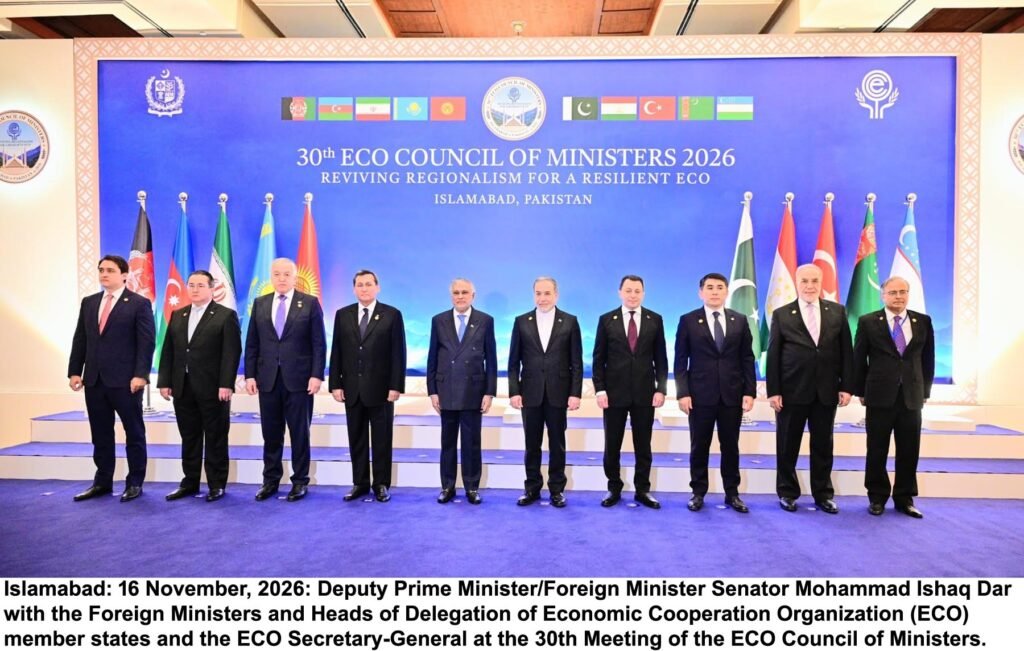
The 30th Meeting of the Economic Cooperation Organization (ECO) Council of Ministers was held in Islamabad on 15-16 November 2026, chaired by Deputy Prime Minister and Foreign Minister Ishaq Dar. The meeting gave Pakistan a chance to show itself as a convener of regional diplomacy and a hub for trade and transit.
ECO was founded in 1985 by Pakistan, Iran and Türkiye and expanded in 1992 to ten members. Together they have a nominal GDP of about $3 trillion and, as former AJK President Sardar Masood Khan has noted, a contiguous geography suited to trade and transport links. Critics say the bloc has long fallen short of that potential, with intra-regional trade low and agreements slow to take effect.
Pakistan, which holds the chair for 2026-27, set the theme “Reviving Regionalism for a Resilient ECO.” Its Foreign Office said the chairmanship would focus on strengthening regional connectivity and deepening integration. It also presented the role as a chance to position Pakistan as a regional connectivity hub, a facilitator of logistics supply chains and an agenda-setter for regional trade.
Senior officials met first to finalise the agenda and the draft Islamabad Communiqué for the ministers.
- Adopting the Islamabad Declaration and approving a new ten-year framework to 2035 for connectivity, economic integration and sustainable growth.
- Advancing the ECO Trade Agreement (ECOTA) and the Transit Transport Framework Agreement (TTFA) to ease trade and cross-border movement.
- Building on Pakistan’s recent bilateral trade arrangements with Central Asian states and Azerbaijan to expand commerce and strengthen supply chains.
Business voices set out the same expectations. The Islamabad Chamber of Commerce and Industry urged that commitments become tangible gains through private-sector participation, ECO business forums and B2B exchanges. It also highlighted the proposed Uzbekistan-Afghanistan-Pakistan railway as a route linking Central Asia to Pakistani seaports.
Iranian Foreign Minister Abbas Araghchi told the Council that trade, transport and energy should be ECO’s three strategic pillars. He welcomed the new technical committee to reform ECOTA and called for a modern, more inclusive agreement. He also urged regionally owned security dialogue based on non-aggression and a regional energy mechanism to protect supplies. These are Iran’s views, and his sharp criticism of the United States and Israel reflected Tehran’s own position rather than a consensus of members.
The meeting concluded with approval of the Strategic Objectives of Economic Cooperation 2035 and adoption of the Islamabad Declaration, which provides a guiding framework for regional priorities and joint cooperation over the next decade. Sources use slightly different names for the 2035 document, calling it “ECO Vision 2035,” “Strategic Goals 2035” or “Strategic Objectives.”
Pakistan formally took over the chairmanship for 2026 and 2027. It was also decided that Iran will host the 18th ECO Summit on 3-4 December 2026, and Pakistan the 19th Summit in 2027. The Iranian foreign minister said the 2035 plan should be implemented under directives from leaders at the Tehran summit.
On the political side, the joint declaration expressed concern over the region’s challenging geopolitical environment and stressed restraint, dialogue and diplomacy. It commended Pakistan’s mediation toward de-escalation during the recent Iran-US crisis. It also rejected unilateral coercive measures and sanctions, including their extraterritorial economic, technological, financial or trade impacts. Iranian media reported that the declaration also backed Tehran’s initiative to end the conflict and recognised Iran’s role as a founding member. These are Iranian media’s characterisations of the text.
For Pakistan, the meeting brought diplomatic prestige and a platform for its connectivity agenda. Whether the bloc’s long record of ambitious documents and modest implementation changes will depend on follow-through. Sardar Masood Khan has argued that ECO must move from ceremonial meetings to measurable outcomes and stronger institutions. He also noted that Afghanistan’s participation is essential for the ideal Central Asia-South Asia corridor, even as security concerns over militant use of Afghan territory persist. Alternative routes through China’s Xinjiang and Iran are emerging in the meantime.
Several tests lie ahead. ECOTA reform and TTFA implementation must produce simpler customs procedures and lower transport costs. Infrastructure projects such as the proposed railway need financing and security. Chambers of commerce and exporters need to see practical benefits, and geopolitical tensions must not overshadow the economic agenda.
The Islamabad meeting set direction and gave Pakistan the lead for the next two years. Its success will be measured in intra-regional trade, investment and jobs.