
City Desk
ISLAMABAD : The two-day International Conference on CPEC 2.0 and Pakistan-China Strategic Partnership commenced at the National University of Modern Languages (NUML), organized by the Faculty of Social Sciences.
The conference brought together policymakers, academics, experts, faculty members and a large number of students to discuss the future direction of Pakistan-China cooperation.
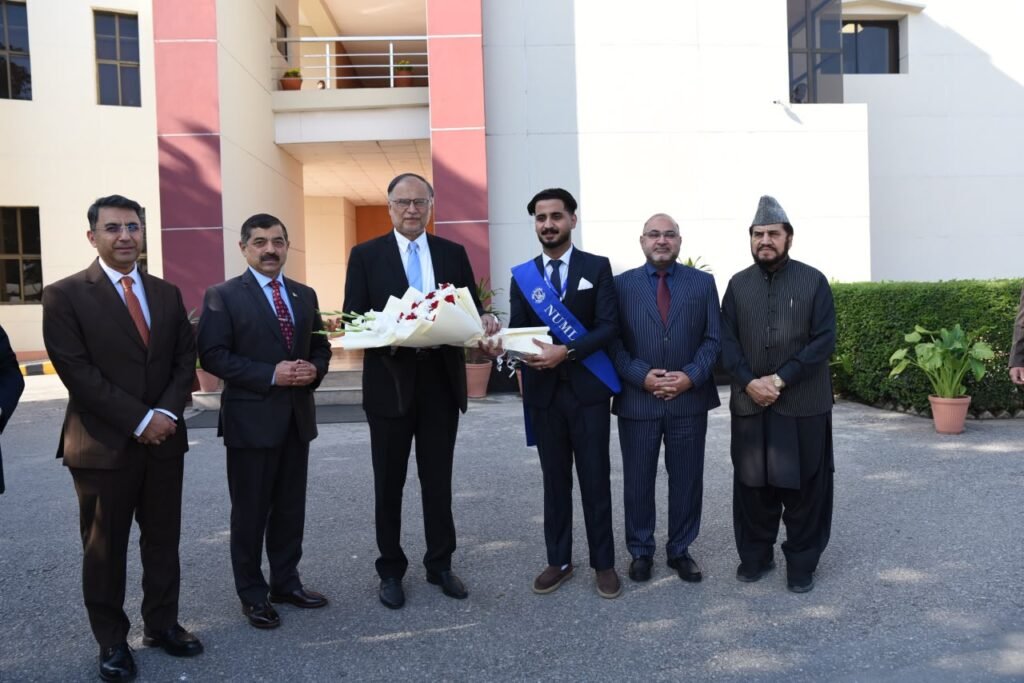
Federal Minister for Planning, Development and Special Initiatives Prof. Ahsan Iqbal attended the inaugural session as Chief Guest, while Vice Chancellor PIDE Dr. Nadeem Javed delivered the keynote address. Rector NUML Maj Gen Shahid Mahmood Kayani, HI(M) (Retd), DG NUML Brig Muhammad Rafiq Khan, Deans, Directors and faculty members also attended the session.
The proceedings commenced with the national anthem and recitation, followed by introductory remarks by Prof. Dr. M. Riaz Shad, Dean, Faculty of Social Sciences, NUML.
Addressing the conference, Prof. Ahsan Iqbal described the present era as a “knowledge revolution” driven by rapid technological advancement. He termed Pakistan and China natural partners in pursuing shared development goals and highlighted the strategic significance of CPEC.
He said the next phase of CPEC should focus on growth, skills and livelihood development, knowledge, innovation, green development, technology and human capital.
The Federal Minister stressed that Pakistan’s sustainable development requires peace and security, political stability, continuity of policies and structural reforms.
Highlighting youth development, he said 10,000 Pakistani youth will receive training in emerging sciences from Chinese universities, while further training opportunities are also being expanded in agriculture. He urged the youth to emulate the spirit of Allama Iqbal’s Shaheen, referring to the launch of the “Bano Shaheen Programme.”
In his keynote address, Dr. Nadeem Javed highlighted the strategic importance of CPEC corridors and stressed that technology transfer must be accompanied by the development of Pakistan’s own technological, institutional and productive capabilities. He noted that CPEC 2.0 builds upon the achievements of the first phase and called for Pakistan’s economic and institutional systems to remain aligned with China’s evolving priorities. He underlined that CPEC 2.0 marks a shift from connectivity to competitiveness, and Pakistan’s major challenge is ensuring adequate domestic preparedness to capitalize on this transition.
In his concluding remarks, Rector NUML Maj Gen Shahid Mahmood Kayani thanked the participants and organizers and emphasized the importance of understanding and applying Allama Iqbal’s vision and teachings in practical life.
Along with the inaugural and closing ceremonies, the conference comprises six parallel sessions focusing on Growth Corridor, Regional Connectivity Corridor, Green Corridor, Innovation Corridor, Livelihood Corridor, and Building Bridges of Understanding. The conference will continue tomorrow.