 Dr. Hasan Yaser Malik
The changing character of global security is increasingly challenging traditional concepts of strategic stability. For decades, nuclear deterrence remained the central pillar of security calculations among nuclear-armed states, particularly in South Asia, where India and Pakistan developed nuclear capabilities to prevent large-scale conventional war. However, contemporary geopolitical realities suggest that strategic competition is no longer confined to nuclear arsenals, missile capabilities and conventional military strength. Maritime chokepoints, energy supply routes, economic interdependence and control over critical infrastructure are emerging as equally consequential instruments of strategic influence. In this evolving environment, the Strait of Hormuz represents a significant example of what may be described as the transition from nuclear deterrence towards chokepoint deterrence.
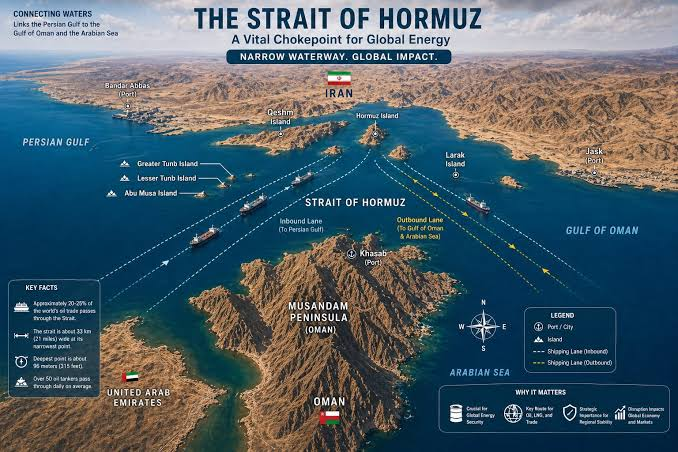
The Strait of Hormuz, connecting the Persian Gulf with the Gulf of Oman in Arabian Sea, is among the world’s most strategically important maritime passages. According to the US EIA, approximately 20.7 (25% of global oil trade) million barrels of oil per day passed through the strait in 2024. During the first half of 2025, these flows increased to approximately 20.9 million barrels per day. Furthermore, about 20 % of global LNG trade also transited this narrow waterway in 2024. These figures establish that Hormuz is a critical artery of the international supply chain and economic system.
Its strategic significance becomes even more pronounced when the destination of these energy supplies is considered. The EIA estimates that approximately 84 % of crude oil and condensate transported through Hormuz in 2024 was destined for Asian markets. China, India, Japan and South Korea collectively accounted for 69 % of these flows. Consequently, any prolonged disruption in the strait had implications extending far beyond the Gulf region including Europe which is predominantly dependent upon Russia, directly affecting Asian economies, industrial production, energy prices and national security calculations.
This development introduces a broader understanding of deterrence. Traditional nuclear deterrence seeks to prevent aggression through the threat of unacceptable military retaliation. Chokepoint deterrence, by contrast, concerns the strategic leverage generated by a state’s geographical position, maritime access, and control over critical shipping routes and potential influence over energy transportation. It does not necessarily require direct military confrontation. Even the possibility of disruption can generate economic uncertainty, increase insurance premiums, disturb energy markets and compel external powers to reconsider their regional commitments.
For South Asia, these developments carry particularly serious implications. Both India and Pakistan operate within a complex security environment characterised by unresolved political disputes, conventional military competition and nuclear deterrence. According to the Stockholm International Peace Research Institute (SIPRI) Yearbook 2025, India possessed an estimated 180 nuclear warheads, while Pakistan possessed approximately 70 at the beginning of 2025, moreover it is critical to understand that India possesses second strike capability.
It is getting evident that nuclear deterrence alone cannot guarantee comprehensive strategic stability. The economic and maritime dimensions of national security are becoming increasingly interconnected with traditional military calculations. India has substantial energy interests in the Gulf, while Pakistan’s geographical proximity to the Arabian Sea and its dependence on imported energy make maritime security particularly important. A serious disruption in Hormuz could increase energy import costs, intensify inflationary pressures, strain foreign exchange reserves and create additional economic vulnerabilities across the region.
The implications are not exclusively economic. They also have geopolitical and strategic dimensions. India’s growing maritime ambitions in the Indian Ocean, Pakistan’s strategic position along the Arabian Sea, and the involvement of external powers in Gulf security create an increasingly interconnected strategic environment. The possibility of competition over maritime access, naval presence and protection of commercial shipping could introduce additional tensions into an already sensitive South Asian security architecture.
The May 2025 India-Pakistan military crisis further demonstrated that nuclear weapons do not automatically eliminate the possibility of conventional confrontation. Instead, crises can unfold below the nuclear threshold while generating significant escalation risks. In such circumstances, economic pressure, maritime insecurity and disruption of critical supply chains could become additional instruments of strategic coercion. The resulting situation may complicate conventional crisis management and create new uncertainties for nuclear-armed neighbours.
However, it would be suitable to suggest that the Strait of Hormuz directly influences nuclear stability in South Asia. It also signifies that how developments around the immediate India-Pakistan rivalry can influence regional and extra regional strategic calculations. A crisis in the Persian Gulf could simultaneously affect energy security, maritime deployments, diplomatic alignments and economic resilience in South Asia. This interconnectedness makes strategic stability increasingly multidimensional and potent to extent that superpower like US has not achieved it diplo-military objectives against Iran in Hormuz, it is vital to consider that most vital chokepoints sits in Muslim Territorial waters.
Therefore, Pakistan and India must recognise that future strategic stability requires more than maintaining credible nuclear deterrence. Both countries need stronger maritime confidence-building measures, improved communication mechanisms, protection of commercial shipping and cooperation against disruptions to critical sea lanes. Regional dialogue on energy security and maritime risk reduction should become an integral part of broader security discussions as Sir Creek Issue leading to conflict of EEZ rights is getting more significant in an already fragile Indian Ocean as China is enhancing its naval and diplomatic influence against US influence.
Ultimately, the Strait of Hormuz symbolises a transformation in contemporary strategic thinking: power is no longer measured exclusively by nuclear warheads, military platforms or territorial control. Hence future regional stability will depend not only on preventing nuclear war but also on managing the geopolitical consequences of chokepoint competition in an increasingly interconnected world.
The writer is defence analyst. He is associted with Maritime Centre of Excellence.